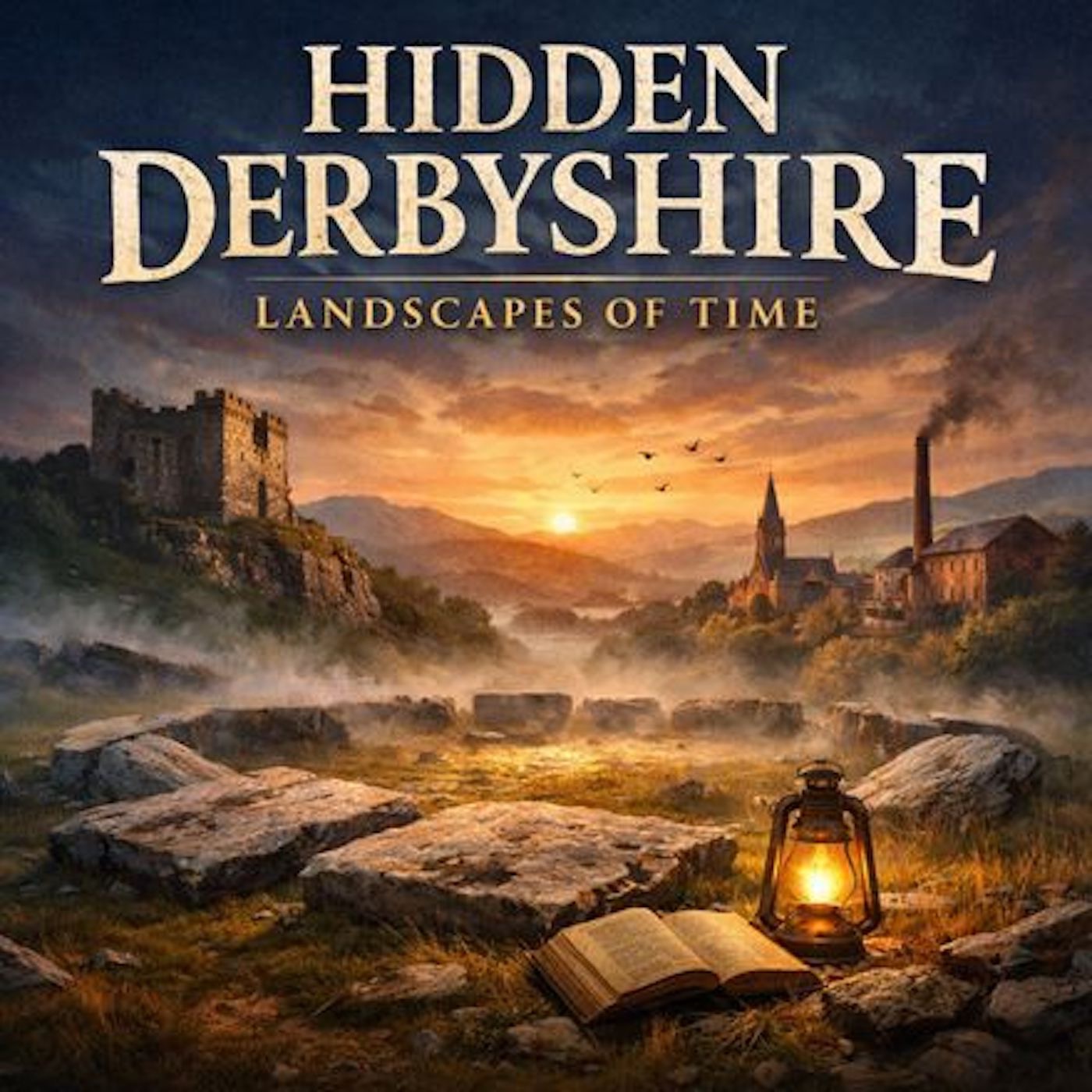
Navio: The Roman Fort in the Mist
Tonight's Episode
High above the Hope Valley lie the remains of Navio — a Roman fort built not for spectacle, but for logistics. Positioned among lead mines, roads, and rugged frontier landscapes, Navio reveals how the Roman Empire functioned at its edges: through supply chains, administrators, and auxiliary soldiers far from home.
In this episode, we explore Rome’s quiet machinery in Derbyshire: the roads, the ore, the soldiers, the civilians, and the slow decline that turned an imperial outpost into grass.
*Hidden Derbyshire: Landscapes of Time*
A documentary storytelling podcast about the places where history, archaeology, and landscape intersect.
**Primary Archaeological & Excavation Sources**
* **St. Joseph, J.K.** (1955). *Air Reconnaissance of Roman Britain*.
— Early aerial photography confirming fort layout & ditch systems.
* **Derbyshire Archaeological Journal** (various vols., late 19th–20th c.).
— Excavation notes, measurements, fort plan interpretations.
* **Jones, G.D.B. & Mattingly, D.J.** (1990). *Atlas of Roman Britain*.
— Regional context; positioning of Navio in northern frontier network.
* **Hart, Cyril** (1981). *North Derbyshire Archaeology*.
— Site-specific synthesis; lead industry + Roman infrastructure.
* **Historic England Scheduling Records** — Navio / Brough Fort.
— Official designation, phase notes, earthwork mapping.
**Roman Roads & Infrastructure Sources**
* **Margary, I.D.** (1967). *Roman Roads in Britain*.
— Numbering system & proposed routes linking Navio to Buxton, Chesterfield, Manchester.
* **Webster, G.** (1985). *The Roman Imperial Army*.
— Fort typologies & logistical rationale for frontier placements.
* **Shotter, D.** (2004). *Roman Britain*.
— Short but useful synthesis, logistics > conquest framing.
**Lead Mining & Industrial Context**
* **Willies, Lynn** (1999). *Lead Mining in the Peak District*.
— Industry continuity from pre-Roman through post-medieval.
* **Barnatt, John & Smith, K.** (2004). *The Peak District: Landscapes Through Time*.
— Integrates mining, settlement, and military impact.
**Frontier & Garrison Culture**
* **Mattingly, D.** (2006). *An Imperial Possession: Britain in the Roman Empire*.
— Crucial for understanding frontier hybridity & provincial identity.
* **Simpkins, J.** (2018). *Auxiliaries in Roman Britain*.
— Material culture + mixed-garrison ethnography.
**Religion, Identity & Cultural Blending**
* **Henig, Martin** (1995). *Religions in Roman Britain*.
— Altars, syncretism & local cult integration; relevant to Buxton context (Aquae Arnemetiae).
* **Hingley, Richard** (2000). *Roman Officers and English Gentlemen*.
— Reception studies + imagined frontiers.
**Chronological Context**
* Fort phases:
✔ **Late 1st century AD** timber/turf
✔ Later **stone rebuilds**
✔ **Gradual contraction** in late empire
* Withdrawal from Britain: early **5th century AD** (approx.)
### **Consensus Statements**
Most archaeologists agree:
✔ Navio’s primary purpose = **logistics + administration + mineral control**
✔ Fort sits within Peak District lead-mining network
✔ Roads linked Navio ↔ Buxton ↔ Chester ↔ northern routes
✔ Garrison included **auxiliaries**, not legionaries
✔ Decline was gradual, not catastrophic
✔ Little monumental architecture expected at a frontier cog
**Open Questions / Interpretive Gaps**
Still debated:
• exact scale of mining operations supplying Rome
• proportion of civilian vs military population in vicus
• role of local tribes in ore extraction (labour vs taxation)
• religious footprint inside the principia (altars now lost)
### **Accessible Public Sources**
For general listeners:
* Peak District NPA heritage notes
* Buxton Museum & Art Gallery (Roman + mining exhibits)
* Derbyshire Archaeological Society publications
* Local walking trails with Roman heritage overlays
Advertising Inquiries: https://redcircle.com/brands
Privacy & Opt-Out: https://redcircle.com/privacy
[SPEAKER_00]: The Roman Empire rarely ends with a wall. [SPEAKER_00]: It ends with weather and roads and paperwork and the quiet calculations of frontier life.
[SPEAKER_00]: Up here in the Hope Valley, the Empire arrived not as conquerors in chariots, but as saveyors with ink stained fingers,
[SPEAKER_00]: Navio sits just above broth while a gentle slope with the commanding view across the valley. [SPEAKER_00]: The site is modest, grass, earthworks, fragments of warring, hints of ramparts hidden beneath the turf. [SPEAKER_00]: Walk past it quickly and you might not even realise you've crossed a Roman footprint. [SPEAKER_00]: But the Romans didn't build faults for aesthetics. [SPEAKER_00]: They built them for
[SPEAKER_00]: Darbysher matted to Rome for one reason above all. [SPEAKER_00]: Lead. [SPEAKER_00]: The peak district was rich with veins of all, thick seams drawn through the limestone like pencil strokes. [SPEAKER_00]: Rome used lead for pipes for weights, for sling bullets, for sealing amphora, and for thousands of unglamorous tasks that kept an empire running. [SPEAKER_00]: Lead doesn't make headlines, but it makes infrastructure.
[SPEAKER_00]: but he wasn't just the mines. [SPEAKER_00]: The Hope Valley settlement network of roofs eastwards the Durwint and the Trent, west towards Manchester, and south towards Derby and the Midlands, and north towards some penines and onwards to Adrian's Wall. [SPEAKER_00]: Navio was not an isolated garrison. [SPEAKER_00]: It was a junction.
[SPEAKER_00]: Romans are remembered for their roads because their roads worked. [SPEAKER_00]: Straight, efficient, engineered to ignore landscape reluctance. [SPEAKER_00]: But roads did more than just move soldiers. [SPEAKER_00]: They moved information, taxes, or correspondence and culture. [SPEAKER_00]: from Navio roots ran towards Buchston, Aquaramitia, the sparsestlement dedicated to a local goddess. [SPEAKER_00]: Further still, roads linked to Chester, Diva and York, and the complex frontier infrastructure of the North.
[SPEAKER_00]: Look at a Roman map and written divides into zones, heartlands, coasts, and ages. [SPEAKER_00]: The places when negotiations happen. [SPEAKER_00]: The first fort in Avio was likely built in the late 1st century AD in Timber and Turf. [SPEAKER_00]: These early forts were fast to build and fast to alter. [SPEAKER_00]: Later phases show stone rebuilding, internal reorganization and a reduction in size. [SPEAKER_00]: This is often a sign that large garrisons were no longer required. [SPEAKER_00]: At its height, Navio would have contained barracks, grainaries, workshops, stables, and drainage, all arranged around the Principia, the headquarters at the Fort Centre.
[SPEAKER_00]: Roman forts are formulated because the Empire believed order should be visible.
[SPEAKER_00]: Imagine the Garrison, auxiliary soldiers drawn from across the empire, Gauls, Germans, and Spaniards, men who knew what a sunrise looked like through different skies. [SPEAKER_00]: They drilled in the yard, maintained their equipment, wrote letters and gambled. [SPEAKER_00]: Archaeologist find gaming counters, boot hop nails, pottery shards, broochers, occasional personal trinkets, objects that collapse the gap between Roman and human. [SPEAKER_00]: The empire was not marble and glory, it was payroll and boredom and discipline.
[SPEAKER_00]: Beside the fort Grauvicus, a civilian settlement, traitors, smiths, labres, bath attendants and families, where soldiers stayed for years, civilian stayed for generations. [SPEAKER_00]: This is where Roman Britain becomes hybrid. [SPEAKER_00]: Local deities were worshiped alongside Roman ones. [SPEAKER_00]: pottery styles blended, [SPEAKER_00]: Frontiers make interesting children.
[SPEAKER_00]: Roman religion was permissive, almost administrative. [SPEAKER_00]: Concord people were allowed their gods, so long as they did not obstruct Imperial business. [SPEAKER_00]: In books, in a local water goddess became Romanized, shrines merged rather than clashed. [SPEAKER_00]: At Navio, the record is thinner. [SPEAKER_00]: which auxiliary units often imported their own gods, carving names into altars, or erecting small, votive stones in the Prince of Peer. [SPEAKER_00]: Identity in the frontier was not erased, it was edited.
[SPEAKER_00]: Northern Britain resisted Rome less-through-pitched battles, and morphed through nutrition. [SPEAKER_00]: Distance rain, cold, and the terrain, these were Britain's standing armies. [SPEAKER_00]: Rome suffered not through enemy generals, but from logistics, grains supply, or transport, and pace schedules. [SPEAKER_00]: Navio declined gradually. [SPEAKER_00]: The fort shrank as priorities shifted, and then fell silent.
[SPEAKER_00]: When Rome withdrew in the early 5th century, there was no proclamation, no grand departure. [SPEAKER_00]: The empire simply lost interest, soldiers stopped returning. [SPEAKER_00]: The fort became grass.
[SPEAKER_00]: Stand at Navio today and you won't see columns or frescoes. [SPEAKER_00]: You'll see outline rectangular suggestions beneath the turf.
[SPEAKER_00]: You'll hear sheep, the usual crows, and the persistent dubs your weather.
[SPEAKER_00]: But if you bring a Roman road map, or a list of mines, or even just imagination, the logic becomes obvious. [SPEAKER_00]: Navio was a cog in the machine, and machines do not care about spectacle. [SPEAKER_00]: They care about efficiency.
[SPEAKER_00]: Empires leave cities behind, frontiers leave ghosts. [SPEAKER_00]: Navio is one of the few places where you can stand at the age of Rome, and realize that the edge was not a defensive line. [SPEAKER_00]: It was a conversation.
[SPEAKER_00]: This has been hidden abysher, landscapes of time. [SPEAKER_00]: If you enjoyed the journey, follow the show, and share it with someone who loves history, folklore, or even a good mystery. [SPEAKER_00]: Until next time, walk gently and listen closely.
 Apple Podcasts
 Castbox
 Castro
 Goodpods
 Moon FM
 Overcast
 Pocket Casts
 Podbean
 Podcast Addict
 Podcast Republic
 Spotify