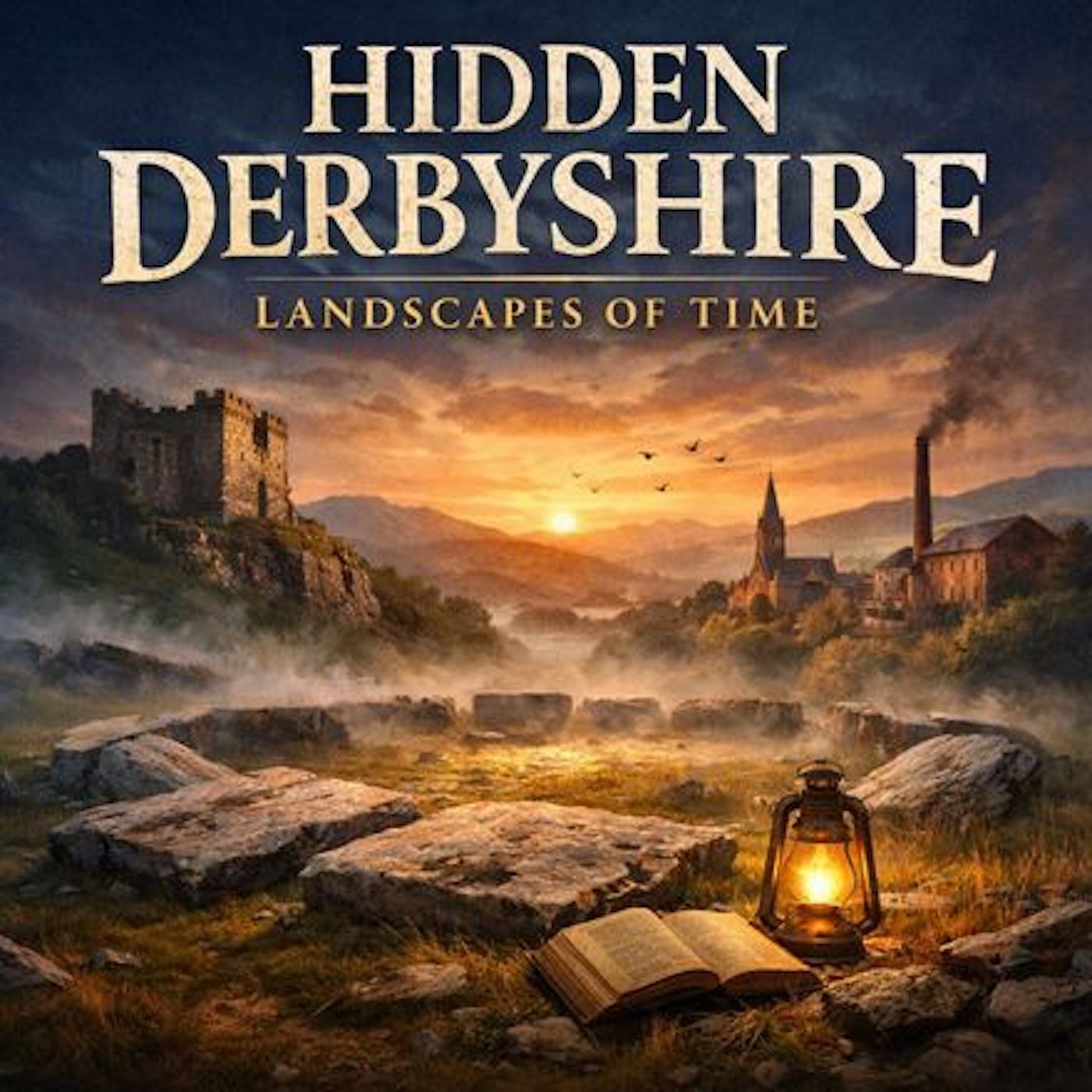
The Nine Ladies of Stanton Moor: A Dance Turned to Stone
Tonight's Episode
High on Stanton Moor, a small circle of weathered stones stands quietly among the heather. Known as the Nine Ladies, their origins lie deep in prehistory—but their meaning has long been shaped by story.
In this episode of Hidden Derbyshire: Folklore & Legends, we explore one of the county’s most enduring tales: nine women, said to have been turned to stone for dancing on the Sabbath. Alongside the legend, we uncover the recorded history of the site, its place within a wider tradition of British petrification folklore, and the way landscapes hold memory long after their original purpose is forgotten.
Blending documented tradition with quiet reflection, this episode looks at how folklore grows from uncertainty—and why places like Stanton Moor continue to feel significant, even now.
Advertising Inquiries: https://redcircle.com/brands
Privacy & Opt-Out: https://redcircle.com/privacy
[SPEAKER_00]: There are places where the past seems distant, contained, measured and dates, artifacts and records.
[SPEAKER_00]: And then there are the places where the past feels closer than that. [SPEAKER_00]: Not visible, not fully understood, but present. [SPEAKER_00]: stands more as one of those places. [SPEAKER_00]: A stretch of open land above the Doant Valley, quiet, exposed, unassuming at first glance, looked scattered across it, or signs, subtle, easily missed, that people have been coming here for thousands of years, [SPEAKER_00]: building, marking, remembering. [SPEAKER_00]: At the centre of a tall, a small circle of stone, nine upright rocks arranged in a ring, weathered by time, softened by light shen, standing without explanation.
[SPEAKER_00]: Known as, the nine ladies, and according to the story that has survived for generations, [SPEAKER_00]: though it never meant to be stones at all.
[SPEAKER_00]: Before the story, there is always a place. [SPEAKER_00]: Stanton Moore sits between Berkhova and Stanton in the peak, rising gently above the surrounding valleys. [SPEAKER_00]: It isn't dramatic in the way that the central peak district can be. [SPEAKER_00]: There are no steep apartments, no towering riches. [SPEAKER_00]: Instead, it's open, Heather covered, scattered with grit stone out crops at rise from the ground-like fragments of something gold. [SPEAKER_00]: And across this landscape there are signs of human activity stretching back thousands of years.
[SPEAKER_00]: There are burial mounds, standing stones, earthworks, subtle changes in the land that suggest that this wasn't just a place people passed through. [SPEAKER_00]: It was somewhere they returned to, repeatedly. [SPEAKER_00]: The 9-lady stone circle sits within this wider landscape, and it's small of the most people expect. [SPEAKER_00]: Around 10 meters in diameter, nine stones forming a rough ring. [SPEAKER_00]: And even in height, he regular in spacing. [SPEAKER_00]: Not a monumental in the way of Stonehenge or Avery, but intimate, close.
[SPEAKER_00]: A space you can step into and feel enclosed by, even under the open sky. [SPEAKER_00]: And just beyond it, a single upright stone, set apart, known as the King Stone. [SPEAKER_00]: The story attached to the 9 ladies is simple, and like many of the oldest stories, it doesn't need complexity. [SPEAKER_00]: According to local tradition, the stones were once nine women. [SPEAKER_00]: In some tellings they were villages, in others, dancers, in other still maidens, but always they are together.
[SPEAKER_00]: And always they are moving. [SPEAKER_00]: Dancing in a circle, but they are dancing on a Sunday, and in older versions of this story that detail is everything. [SPEAKER_00]: Because the Sabbath in modern England wasn't just a religious observance, it was a boundary, a day set apart. [SPEAKER_00]: It was a time when certain behaviours, music, dancing, celebration, we're not just discouraged, but seen as violations. [SPEAKER_00]: So, when they were women danced, they weren't simply enjoying themselves, they were crossing a line.
[SPEAKER_00]: and in folklore, crossing a line, always has consequences.
[SPEAKER_00]: The story says they were seen, interrupted, caught in the act, and in that moment, they were turned to stone. [SPEAKER_00]: Not gradually, not symbolically, but instantly, frozen where they stood, the dance stopped forever.
[SPEAKER_00]: And the Kingstone, that depends on who tells you the story.
[SPEAKER_00]: The Kingstone stands apart from the circle, a single upright figure, positioned just far enough away to feel separate, but close enough to remain connected. [SPEAKER_00]: And like all elements of folklore, its meaning shifts. [SPEAKER_00]: In some versions the King Stone is a musician, a fiddler, the one who played while the women danced, and when the punishment came, he was turned to stone as well, condemned not just to stand still, but to watch, forever. [SPEAKER_00]: In other telling the King Stone is something else, a watcher, a figure of authority.
[SPEAKER_00]: Someone who witnessed the transgression and brought about its consequence. [SPEAKER_00]: And in darker interpretations, he is neither musician nor man, but something older, something tied to the land itself. [SPEAKER_00]: A presence as enforcers and rules without ever needing to explain them. [SPEAKER_00]: What matters isn't which version is correct because folklore rarely settles on one answer. [SPEAKER_00]: What matters is that a stone is never just a stone. [SPEAKER_00]: It is always a figure, a role, a meaning placed onto the landscape.
[SPEAKER_00]: This story isn't a modern invention. [SPEAKER_00]: Fursions of the nine ladies' legend appeared in antiquarian writings from the 18th and 19th centuries. [SPEAKER_00]: Local guidebooks, regional histories, collections of oral tradition, and while the details vary, the core remains the same. [SPEAKER_00]: Women dancing, a forbidden day, [SPEAKER_00]: This places the nine ladies with an a much wider category of British folklore, known as Petrification Legends, stories where people are turned to stone for breaking a rule, three stories appear across the country, dancers turn to stone for celebrating on a Sunday, musicians froze and made performance, and groups caught in acts considered improper or excessive.
[SPEAKER_00]: And almost always, there is a moral structure beneath the story, a sense that the landscape itself reflects behavior. [SPEAKER_00]: That actions leave marks, and that consequences can be permanent. [SPEAKER_00]: In this way, the nine ladies aren't just at local curiosity, they are part of a pattern, a way of explaining ancient monuments in a world where their original purpose had been forgotten. [SPEAKER_00]: Because by the time these stories were recorded, no one remembered why the stones had been placed there, only that they'd were there, and that they must mean something.
[SPEAKER_00]: Archaeologically, the stone ladies are believed to date from the Bronze Age. [SPEAKER_00]: They are likely to be constructed around three to four thousand years ago. [SPEAKER_00]: The purpose is in certain. [SPEAKER_00]: They may have been a ritual side to gathering place, a funerary monument, or something else entirely. [SPEAKER_00]: We just don't know. [SPEAKER_00]: And that uncertainty is important. [SPEAKER_00]: because folklore often begins where knowledge ends. [SPEAKER_00]: When people encounter something ancient and unexplained, they don't leave it empty.
[SPEAKER_00]: They fill it with the story, with meaning, with memory.
[SPEAKER_00]: The nine ladies of the election are not an attempt to preserve the original truth of the stones. [SPEAKER_00]: They are an attempt to make sense of their presence, to explain why something so deliberate, so structured, exists in the landscape, and why it feels significant. [SPEAKER_00]: Beyond the main legend, there are quieter traditions, less widely recorded, but still persistent. [SPEAKER_00]: Stories at the stones are not entirely silent, but under certain conditions they can be heard.
[SPEAKER_00]: These kinds of reliefs appear in other stone circles across Britain. [SPEAKER_00]: Associations between stone, sound and unseen movement. [SPEAKER_00]: And while there's no evidence to support these claims in a physical sense, they tell us something important about perception. [SPEAKER_00]: because places like Stanton Moore don't just exist visually. [SPEAKER_00]: They are experienced through sound, through silence, through the way the wind moves across the open ground, and in the environment.
[SPEAKER_00]: It's not difficult to understand how the idea of something lingering, something just beneath the surface, might take hold.
[SPEAKER_00]: Stanton Moore isn't defined by a single monument. [SPEAKER_00]: The 9 ladies are just one part of a wider landscape filled with prehistoric features, barrels and standing stones carved out crops. [SPEAKER_00]: And when you move through the area, you begin to notice how these elements relate to one another. [SPEAKER_00]: Not in straight lines, but in placement, invisibility, in how one site leads to another. [SPEAKER_00]: This is what gives them more its character, not just age but continuity.
[SPEAKER_00]: A sense that this has been a meaningful place for a very long time, and that meaning didn't disappear when the original builders were gone. [SPEAKER_00]: It changed, it adapted, it shaped into folklore, into story, and into interpretation.
[SPEAKER_00]: By the 19th century the nine ladies have become a known sight, it was visited by travellers and it was described in guidebooks, studied carefully or otherwise, by antiquarians trying to catalogue Britain's ancient past. [SPEAKER_00]: And during this period something interesting happens. [SPEAKER_00]: The scientific and the folkloric begin to overlap. [SPEAKER_00]: Riders document the stone, they measure them, speculate about their origins. [SPEAKER_00]: But at the same time, they record the stories attached to them.
[SPEAKER_00]: Sometimes with curiosity and others with skepticism. [SPEAKER_00]: but they recall them nonetheless, and because of that, the legend of nine ladies survives in written form, not just an oral tradition, but as part of the historical record. [SPEAKER_00]: It's easy to look at stories like this and dismiss them, to see them as a superstition, and something belonging to a less informed past. [SPEAKER_00]: But that misses their function. [SPEAKER_00]: Folklore isn't just about belief, it's about structure, about how people organise the world around them.
[SPEAKER_00]: The nine-lady stories is at its core about boundaries, about behaviour, and what happens when those boundaries are crossed. [SPEAKER_00]: It reflects a time when social and religious rules were deeply embedded in everyday society, and it expresses those rules through law or instruction, but through narrative, through consequence, through transformation. [SPEAKER_00]: And even now, removed from that context, [SPEAKER_00]: The structure of the story still feels familiar, because the idea that actions leave marks that behaviour has consequences, that certain lines shouldn't be crossed, hasn't disappeared.
[SPEAKER_00]: It's just changed form. [SPEAKER_00]: Today, people still visit the nine ladies, walk across Stanton Mall, they stand within the circle and often, without knowing the full history, they feel something. [SPEAKER_00]: Not necessarily super natural, but noticeable, a shift in atmosphere a sense of quiet, [SPEAKER_00]: and that experience that subtle awareness is what keeps places like this alive, not the certainty of their origin, but the feeling they create.
[SPEAKER_00]: The nine ladies have stand to more, or in one sense, just stones. [SPEAKER_00]: Placed thousands of years ago, for reasons we may never fully understand. [SPEAKER_00]: But in another sense, there are something else, a story, a warning, a reflection of how people have tried to make sense of the world around them. [SPEAKER_00]: because when knowledge fades, stories remain and on the stand-to-mole, those stories are still standing.
[SPEAKER_00]: You've been listening to hidden garbage, folklore and legends. [SPEAKER_00]: Next time, we leave the open war behind, and we go underground into darkness, into echo, into a place once known as the Devil's Earth.
 Apple Podcasts
 Castbox
 Castro
 Goodpods
 Moon FM
 Overcast
 Pocket Casts
 Podbean
 Podcast Addict
 Podcast Republic
 Spotify